Best Matter & Zigbee Smart Plug in Canada (Energy Meter)
A bargain-bin smart plug with no real safety listing and no local control can backfire fast: a relay sticking on a basement dehumidifier, cloud servers dropping your schedules, or power readings trapped inside a vendor app. If you want to automate 120 V appliances and see what is actually driving up your Hydro-Québec or provincial utility bill, pick a plug that is local-first, North American safety certified (UL / ETL) and equipped with real wattage and kWh monitoring.
We compared five models sold on Amazon.ca that run with zero monthly subscription and work locally with Home Assistant, Apple Home, Google Home or Alexa—calling out the hardware and firmware quirks of each one.
Quick verdict: which smart plug to buy in Canada
- Best overall Matter value: TP-Link Tapo P110M. Compact, ETL certified, 15 A / 1,800 W, full energy monitoring over Matter 1.3 (after firmware update) and overload shutoff. Its weak point: 2.4 GHz Wi-Fi only, and older stock needs a quick firmware update in the Tapo app before Matter exposes power sensors.
- Best Zigbee pick for Home Assistant: THIRDREALITY Smart Plug Gen3. 100% local with no account or Wi-Fi load, built-in Zigbee 3.0 repeater, ±1% factory-calibrated metering and a “monitoring-only” mode to prevent accidental shutoffs. Its weak point: slightly wider body and a Zigbee coordinator is required.
- Best zero-cloud privacy pick: Eve Energy (Matter over Thread). Zero vendor account, UL certified, acts as a Thread mesh router and carries official Works with Home Assistant certification. Its weak point: pricey per plug and requires a Thread Border Router.
- Most mature Wi-Fi integration in Home Assistant: TP-Link Kasa KP125M. Slim housing, Matter support plus the battle-tested local
python-kasaintegration in Home Assistant that exposes power and energy immediately. Its weak point: TP-Link splits branding across Kasa and Tapo, and Wi-Fi plugs do not build a mesh network. - Best budget Matter multi-pack: Meross Smart Plug Mini MSS315. Very compact, 15 A / 1,800 W, ETL certified and frequently well priced in multi-packs on Amazon.ca. Its weak point: full historical charts stay mostly inside the Meross app until Matter 1.3+ firmware is applied.
Quick comparison
| Model | Local protocol | Max load (120 V) | Safety listing | Local energy in HA | Approximate budget (CAD) |
|---|---|---|---|---|---|
| TP-Link Tapo P110M | Matter (2.4 GHz Wi-Fi) + local Tapo | 15 A / 1,800 W | ETL (North America) | Yes (Matter 1.3+ / Tapo integration) | Around $20 – $65 (single or 4-pack) |
| THIRDREALITY Smart Plug Gen3 | Zigbee 3.0 (+ repeater) | 15 A / 1,800 W | ETL | Yes (ZHA & Zigbee2MQTT, ±1%) | Around $35 – $60 (2-pack or 4-pack) |
| Eve Energy (Matter) | Matter over Thread (+ router) | 15 A / 1,800 W | UL | Yes (native Matter 1.3+, HA certified) | Around $50 – $65 (single) |
| TP-Link Kasa KP125M | Matter (2.4 GHz Wi-Fi) + local Kasa | 15 A / 1,800 W | UL | Yes (local TP-Link integration / Matter) | Around $30 – $70 (2-pack or 4-pack) |
| Meross MSS315 (Matter) | Matter (2.4 GHz Wi-Fi) | 15 A / 1,800 W | ETL | Yes (Matter 1.3+ / Meross integration) | Around $25 – $55 (2-pack or 4-pack) |
Approximate ranges in Canadian dollars; prices vary by pack size and Amazon.ca promotions. Use the “Check the price on Amazon.ca” buttons for today’s price.
The 5 criteria that actually matter for a 120 V Canadian smart plug
1. North American safety certification (UL/cUL, ETL/cETL or CSA). Never plug an uncertified gadget into a 120 V outlet behind an appliance or basement dehumidifier. Look for a recognized UL, ETL or CSA mark printed right on the plug housing.
2. Resistive vs. inductive (motor) loads. A “15 A / 1,800 W” rating almost always assumes a resistive load (lamps, kettles, light heating). Motors and compressors (washers, dehumidifiers, sump pumps, freezers) draw an inrush spike on startup that wears out cheap relays. If you want to monitor a freezer or sump pump without risking an accidental tap-to-off, look for software relay locking or monitoring-only mode. And for 240 V hardwired circuits (baseboard heaters, water heaters, EV chargers), no 120 V wall plug applies—see our home energy monitors guide for Hydro-Québec.
3. Duplex wall outlet clearance. Standard Canadian duplex outlets stack two receptacles vertically. A tall plug blocks the second socket: stick to low-profile horizontal “mini” bodies whenever you want to keep both outlets usable.
4. Wireless protocol: Zigbee, Thread or Wi-Fi Matter. One or two Wi-Fi Matter plugs will never bother your router. Once you cross 10 to 15 plugs, Zigbee or Thread pays off: every mains-powered plug acts as a mesh router/repeater, strengthening coverage for battery-powered leak, door and climate sensors. Still deciding between protocols? Read our Zigbee, Thread, Matter or Wi-Fi guide.
5. Power-on recovery after an outage. Winter ice and wind storms are a fact of life in Canada. Make sure the plug lets you choose its recovery state (“restore last state” or “on”) so a basement dehumidifier or network switch does not stay dead after a two-minute blink.
The 5 smart plugs in detail
1. TP-Link Tapo P110M: best overall Matter value
The Tapo P110M checks almost every box for a hub-free start: a compact body that leaves the second outlet free, full 15 A / 1,800 W capacity, ETL certification, automatic overload shutoff and Matter compatibility with energy tracking. Regularly sold in affordable multi-packs on Amazon.ca, it pairs smoothly with Home Assistant, Apple Home, Google Home and Alexa.
TP-Link Tapo P110M (Matter)
Pros
- Real-time wattage (W) and energy (kWh) exposed locally via Matter 1.3+ or the local TP-Link integration in Home Assistant
- Compact horizontal design that keeps the adjacent duplex outlet accessible
- Built-in overload protection (auto power-off above a custom watt threshold) and ETL-certified V-0 flame-retardant housing
- Strong per-plug value when purchased in a 2-pack or 4-pack on Amazon.ca
Cons
- Earlier stock ships with older firmware and requires a quick update in the Tapo app (1.3.2+) before Matter exposes energy sensors
- 2.4 GHz Wi-Fi only: does not extend Zigbee or Thread mesh networks
- Some Home Assistant users report energy entities going briefly unavailable if local NTP/clock access is blocked on an isolated IoT VLAN
For the smoothest Home Assistant setup, update the firmware once in the Tapo app, then onboard the plug locally through Matter or the official local TP-Link Smart Home integration.
2. THIRDREALITY Smart Plug Gen3: best Zigbee plug for Home Assistant
If you already run a Zigbee coordinator—or plan to add one—the THIRDREALITY Smart Plug Gen3 is the most practical way to get 100% local control with zero Wi-Fi traffic and zero vendor accounts. It pairs straight into ZHA or Zigbee2MQTT in seconds, reports factory-calibrated power usage (±1% claimed) and doubles as a rock-solid Zigbee 3.0 repeater.
THIRDREALITY Smart Plug Gen3 (Zigbee)
Pros
- 100% local over Zigbee 3.0: no vendor app, no cloud account, zero extra load on your Wi-Fi router
- Strong Zigbee mesh repeater that improves range for battery-powered leak and contact sensors
- Monitoring-only mode lets you track a freezer or washer without risking an accidental switch-off
- Factory-calibrated (±1% claimed), OTA firmware updates right inside Home Assistant and configurable power-loss recovery
Cons
- Requires a Zigbee coordinator (USB Zigbee stick on Home Assistant or compatible Zigbee hub)
- Slightly wider housing than the Tapo or Kasa minis, which can crowd bulky angled plugs beside it
- No direct Apple Home or Google Home pairing without bridging through Home Assistant or a compatible hub
It is the go-to plug for washer-done alerts, tracking a basement dehumidifier or extending Zigbee coverage toward the garage. If you are building your first local server, see our $300 smart home starter kit.
3. Eve Energy (Matter over Thread): zero cloud and Thread router
Eve sits in a league of its own on privacy: no account to create, no cloud server, no telemetry. The North American UL-certified version (15 A / 1,800 W) speaks native Matter over Thread and holds official Works with Home Assistant certification. Better still, every plugged-in Eve Energy doubles as a Thread router, strengthening the mesh for Thread locks, bulbs and sensors across your home.
Eve Energy (Matter over Thread)
Pros
- Top-tier privacy: zero cloud, zero registration, everything stays strictly local
- Native Matter over Thread with W, V, A and kWh sensors ready immediately for the Home Assistant Energy Dashboard
- UL certified (15 A / 1,800 W) and officially certified Works with Home Assistant
- Built-in Thread router role improves range and responsiveness for other Thread devices
Cons
- Significantly more expensive per unit than the Tapo P110M or THIRDREALITY: costly if you need ten plugs
- Requires a Thread Border Router (Apple TV 4K, HomePod mini, Home Assistant Thread stick, etc.)
- Slightly deeper body than ultra-slim Wi-Fi mini plugs
Eve Energy shines in Apple Home or Home Assistant households investing in Thread for the long haul. Even buying just one or two for central rooms (living room, office, basement) gives your Thread network a dependable backbone.
4. TP-Link Kasa KP125M: proven local Wi-Fi integration for Home Assistant
Within TP-Link’s lineup, the Kasa KP125M shares much of the Tapo P110M’s DNA while adding two welcome strengths: a widely recognized UL listing in Canada and the mature local python-kasa protocol (built into Home Assistant’s official TP-Link Smart Home integration). Its slim form factor stacks cleanly on a duplex outlet or power bar without blocking the neighbour.
TP-Link Kasa KP125M (Matter)
Pros
- Ultra-slim profile that leaves the second wall socket usable, even with two KP125M plugs stacked
- Dual local paths: Matter (Apple Home, Google, Alexa, HA) plus the rock-solid local TP-Link integration in Home Assistant
- UL certified (15 A / 1,800 W), flame-retardant housing and a discreet side power button
- Instantaneous power and cumulative energy entities ready for Home Assistant's Energy Dashboard
Cons
- Runs on 2.4 GHz Wi-Fi only and does not repeat Zigbee or Thread signals
- TP-Link's split between Kasa and Tapo apps can be mildly confusing (though the Tapo app now supports Kasa devices too)
- Energy metrics over pure Matter can vary by hardware revision and firmware: the local TP-Link integration is often more complete in Home Assistant
If you have neither a Zigbee stick nor a Thread Border Router and want a UL-certified Wi-Fi plug that works locally in Home Assistant on day one with zero fuss, the KP125M remains one of the safest picks on Amazon.ca.
5. Meross Smart Plug Mini MSS315: compact budget Matter multi-pack
The Meross MSS315 (North American 120 V / 15 A ETL-certified version) is a strong alternative whenever TP-Link bundles are out of stock or priced higher on Amazon.ca. Its mini shell is neatly built, the physical button is easy to reach, and Matter onboarding over Bluetooth and 2.4 GHz Wi-Fi takes only a minute.
Meross Smart Plug Mini MSS315 (Matter)
Pros
- Compact 120 V / 15 A (1,800 W) ETL-certified design that leaves the adjacent receptacle free
- Local Matter control across Apple Home, Home Assistant, Alexa and Google Home with no hub required
- Built-in power and energy monitoring, frequently competitively priced in 2-packs or 4-packs on Amazon.ca
- V-0 flame-retardant casing and configurable power-loss recovery behaviour
Cons
- 2.4 GHz Wi-Fi only: no Zigbee or Thread mesh repeating
- Depending on shipped firmware, exposing energy entities in Home Assistant may require a firmware update in the Meross app or the Meross LAN integration
- Smaller Home Assistant community track record than TP-Link or THIRDREALITY
Keep in mind that all five models above are rated for indoor use only. If you want to control a block heater, yard lighting or holiday lights at -25 °C, see our guide to automating Christmas lights and outdoor smart plugs in Canada.
3 practical local automations using a power-monitoring plug
Once your plug is linked locally to Home Assistant (Zigbee, Matter or local TP-Link), the wattage sensor (sensor.washer_plug_power) unlocks far smarter automations than basic timers:
- Washing machine finished alert. When power drops below 5 W for 3 minutes after peaking above 100 W, push a phone notification so wet laundry never sits forgotten.
alias: Washer - cycle finished alert
trigger:
  - platform: numeric_state
    entity_id: sensor.washer_plug_power
    below: 5
    for:
      minutes: 3
condition:
  - condition: numeric_state
    entity_id: sensor.washer_plug_power
    above: 0.5
action:
  - service: notify.mobile_app_phone
    data:
      title: "Washer finished"
message: "The cycle is done—time to move the laundry."- Pause a basement dehumidifier during peak electricity windows (Hydro-Québec Flex D or Ontario TOU). A basement dehumidifier easily pulls 400 to 600 W: pausing it automatically during winter peak events from 6–9 a.m. or 4–8 p.m. takes just a few lines in Home Assistant.
- Catch a tripped breaker or forgotten space heater. Trigger an alert if a freezer plug stays at 0 W for over two hours (tripped breaker or unplugged cord), or if a forgotten space heater is still pulling over 1,000 W after 11 p.m.
Which smart plug fits your setup?
- You run Home Assistant with a Zigbee stick: THIRDREALITY Smart Plug Gen3 (accurate metering, monitoring-only mode, Zigbee repeater).
- You have no hub and want the best Matter value: TP-Link Tapo P110M (or Kasa KP125M if you prefer the mature local
python-kasaintegration). - You want zero cloud and a dependable Thread mesh: Eve Energy (Matter over Thread).
- You want an affordable Matter multi-pack for lamps and small appliances: Meross Smart Plug Mini MSS315.
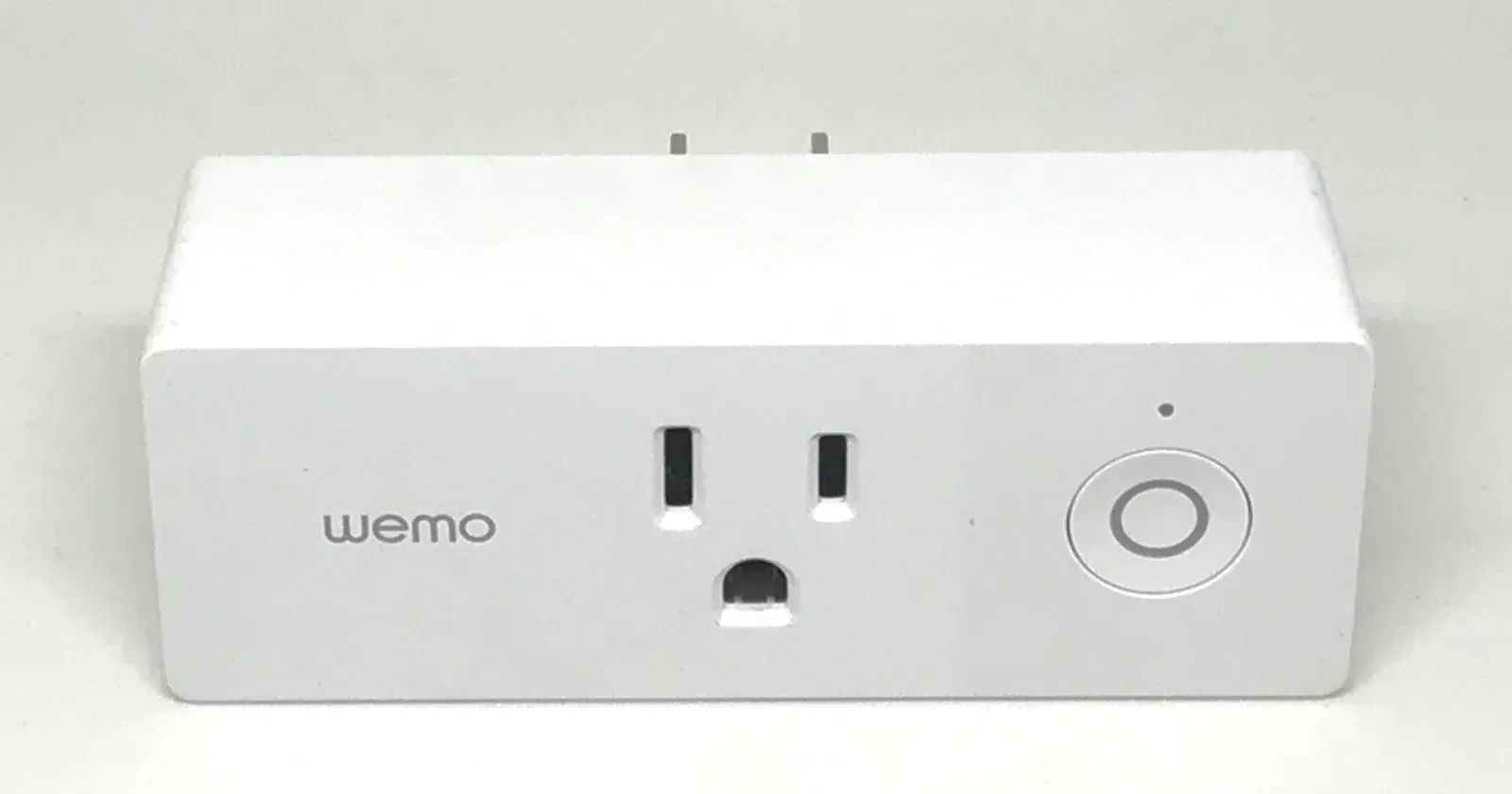
Photo: “Wemo Mini Smart Plug (3755)”, Gregory Varnum, Wikimedia Commons, CC BY-SA 4.0 (cropped and converted).
Frequently asked questions (FAQ)
Can you plug a space heater or dehumidifier into a 15 A smart plug?
In theory, a 15 A / 1,800 W plug can carry a resistive appliance, but running a 1,500 W space heater for hours pushes the internal relay close to its continuous limit. Always use a cUL or cETL certified plug and keep a safety margin. For compressor loads like a dehumidifier, fridge or freezer, verify inductive load tolerance and enable power-monitoring-only mode if available so you never shut the appliance off by mistake.
Does Matter energy monitoring actually work locally in Home Assistant?
Yes, starting with the Matter 1.3 specification supported by Home Assistant. However, not every Matter plug exposes watts and kWh right out of the box: models like the Tapo P110M or Meross MSS315 may require a quick firmware update through the vendor app first, whereas the Eve Energy and Zigbee plugs expose power and energy entities locally right away.
Why are cUL, cETL or CSA certifications essential in Canada?
A smart plug carries up to 1,800 W on a 120 V residential circuit. In Canada, using an uncertified plug increases fire and overheating risk and can complicate a home insurance claim if something goes wrong. Stick to models carrying a recognized North American safety mark (UL/cUL, ETL/cETL or CSA).
What happens to a plugged-in appliance after a power outage?
All five smart plugs in this comparison let you configure power-on behaviour (stay off, turn on, or restore the last state). That setting matters during winter storms in Canada for a freezer, router or dehumidifier: set it to restore last state or power on, then test it by unplugging the smart plug briefly after setup.